
Introduction
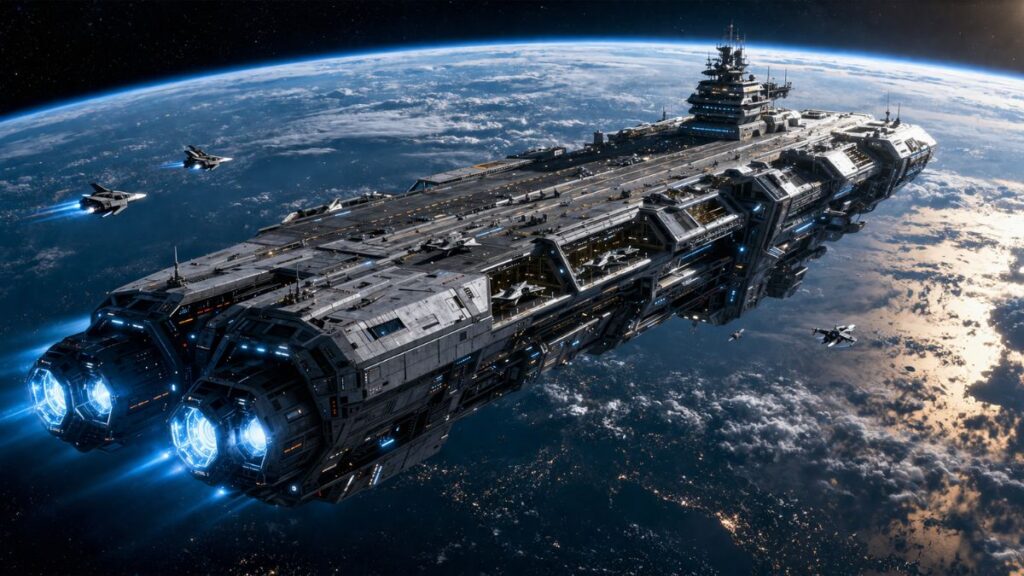
The concept of a space force orbital warship carrier is no longer confined to science fiction. As global powers invest heavily in space defense, the idea of massive orbital platforms capable of deploying spacecraft, conducting surveillance, and projecting power from orbit is becoming increasingly plausible.
In simple terms, an orbital warship carrier is the space-based equivalent of a naval aircraft carrier—but far more advanced. It serves as a mobile command center, launch platform, and defensive stronghold, all operating beyond Earth’s atmosphere.
As space becomes the next strategic frontier, understanding how these systems work—and why they matter—is essential.
What Is a Space Force Orbital Warship Carrier?
A space force orbital warship carrier is a large spacecraft or orbital station designed to:
- Deploy smaller combat or reconnaissance vehicles
- Maintain persistent presence in orbit
- Provide command, control, and communications
- Support offensive and defensive space operations
Key Characteristics
- Massive structural size for docking and storage
- Advanced propulsion systems for orbital maneuvering
- Integrated AI-assisted command systems
- Multi-layer defense mechanisms
Definition
A space force orbital warship carrier is a large space-based military platform designed to launch, support, and coordinate smaller spacecraft while maintaining strategic control in orbit.
Realitykubgs Explained: The Complete Guide to Understanding and Using Realitykubgs in 2026
How Orbital Warship Carriers Work
To understand their importance, it helps to break down how these systems operate.
Core Functional Systems
1. Deployment Systems
These carriers launch:
- Fighter spacecraft
- Surveillance drones
- Interceptor units
2. Command and Control
They act as central hubs for:
- Mission coordination
- Data processing
- Real-time battlefield analysis
3. Defense Systems
Protection includes:
- Laser defense arrays
- Electronic warfare systems
- Anti-satellite interception
Key System Breakdown Table
| System Component | Function | Strategic Advantage |
|---|---|---|
| Launch Bays | Deploy spacecraft | Rapid response capability |
| AI Command Systems | Coordinate missions | Faster decision-making |
| Shielding & Armor | Protect from debris and attacks | Increased survivability |
| Energy Weapons | Defensive/offensive operations | Precision targeting |
| Orbital Thrusters | Maintain or change orbit | Tactical positioning |
Why Orbital Warship Carriers Matter
Space is no longer just for exploration—it’s a contested domain. These carriers play a critical role in shaping future military strategies.
Strategic Importance
- Global Surveillance: Monitor Earth in real time
- Rapid Deployment: Launch missions instantly from orbit
- Deterrence Power: Establish dominance without ground presence
- Satellite Protection: Defend critical infrastructure
Real-World Implications
Governments are increasingly focused on:
- Space-based missile defense
- Anti-satellite technologies
- Orbital logistics systems
This makes orbital carriers a logical next step.
Orbital Carrier vs Traditional Aircraft Carrier
While both serve similar purposes, their environments and capabilities differ dramatically.
Comparison Table
| Feature | Aircraft Carrier | Orbital Warship Carrier |
|---|---|---|
| Environment | Ocean | Space (Low Earth Orbit and beyond) |
| Mobility | Limited by sea routes | 360° orbital movement |
| Deployment Speed | Hours to days | Near-instant |
| Threat Types | Missiles, submarines | Space debris, lasers, cyber attacks |
| Visibility | Detectable | Potential stealth advantages |
| Logistics | Fuel and supplies at sea | Autonomous or robotic resupply |
Technologies Powering Orbital Warship Carriers
The development of a space force orbital warship carrier relies on several cutting-edge technologies.
Advanced Propulsion
- Ion thrusters
- Nuclear propulsion concepts
- Reusable launch systems
Artificial Intelligence
AI enables:
- Autonomous navigation
- Threat detection
- Tactical decision-making
Energy Systems
- Solar arrays for continuous power
- Advanced batteries and storage systems
- Potential nuclear energy sources
Practical Example: Hypothetical Mission Scenario
Imagine a scenario where a satellite network is under threat.
- The orbital carrier detects unusual activity
- AI systems analyze the threat
- Interceptor drones are launched within minutes
- Defensive systems neutralize the threat
- Surveillance continues to ensure security
This rapid response capability highlights why these platforms are so powerful.
Advantages and Disadvantages
Pros
- Faster global response times
- Continuous presence in orbit
- Reduced reliance on ground infrastructure
- High strategic deterrence
Cons
- Extremely high development costs
- Vulnerability to space debris
- Complex maintenance challenges
- Legal and ethical concerns
Common Mistakes in Understanding Orbital Warship Carriers
Many people misunderstand how these systems function.
Misconceptions
- “They are just giant weapons.”
→ In reality, they are multi-role platforms. - “They replace satellites.”
→ They actually support and protect satellite networks. - “They are purely futuristic.”
→ Many technologies already exist today.
Best Practices for Future Development
To successfully build and deploy these systems, experts focus on:
1. Modular Design
Allows upgrades without full replacement
2. Autonomous Operations
Reduces need for human intervention
3. Redundancy Systems
Ensures reliability during critical missions
4. International Regulation Compliance
Prevents escalation and conflict
Development Strategy Table
| Best Practice | Purpose | Impact |
|---|---|---|
| Modular Architecture | Easy upgrades | Long-term cost efficiency |
| AI Integration | Autonomous control | Faster response time |
| Shielding Improvements | Protect against debris | Increased mission lifespan |
| Energy Optimization | Efficient power usage | Sustained operations |
| Cybersecurity Systems | Prevent hacking | Secure command structure |
The Future of Space Force Orbital Warship Carriers
Looking ahead, these systems could evolve into:
- Fully autonomous orbital defense stations
- Multi-carrier fleets working in coordination
- Deep-space mission hubs beyond Earth orbit
As technology advances, the line between science fiction and reality continues to blur.
Conclusion
The rise of the space force orbital warship carrier marks a significant shift in how nations approach defense and security. These platforms are not just about power—they represent adaptability, innovation, and the future of strategic dominance in space.
While challenges remain, one thing is clear: space will play a central role in global security, and orbital carriers could become its most important assets.
FAQs
1. What is a space force orbital warship carrier?
It is a space-based military platform designed to deploy spacecraft and manage operations in orbit.
2. Are orbital warship carriers real?
Not fully operational yet, but many technologies needed already exist and are being developed.
3. What is the purpose of orbital carriers?
They provide surveillance, defense, deployment capabilities, and strategic control in space.
4. How are they powered?
They use solar energy, advanced batteries, and potentially nuclear systems.
5. Will orbital carriers replace satellites?
No, they will support and protect satellite networks rather than replace them.