Introduction
The Jerusalem cross is one of the most recognizable yet deeply symbolic emblems in Christian history. At first glance, it appears simple—a large central cross surrounded by four smaller crosses. However, this design carries centuries of meaning, faith, and cultural influence.
Whether you’ve seen it in historical texts, jewelry, or religious art, the Jerusalem cross continues to spark curiosity. What does it represent? Where did it originate? And why does it still matter today?
In this guide, we’ll break down its history, symbolism, uses, and modern interpretations in a clear, engaging way.
What Is the Jerusalem Cross?
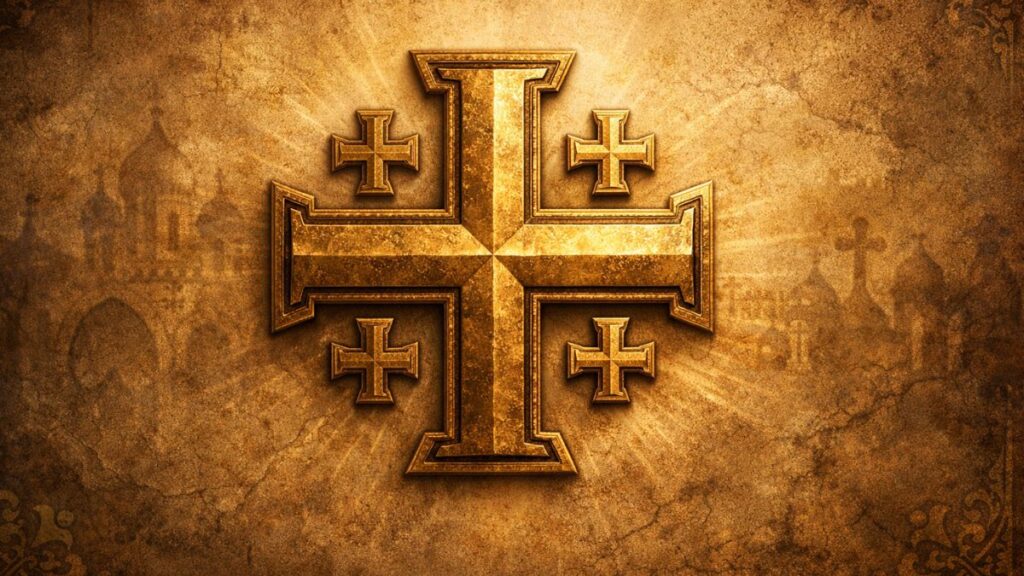
The Jerusalem cross is a geometric symbol made up of:
- One large central cross
- Four smaller crosses in each quadrant
Definition
The Jerusalem cross is a Christian symbol consisting of a large central cross surrounded by four smaller crosses, commonly associated with the Crusades and the Kingdom of Jerusalem.
Origins and Historical Background
The Crusader Connection
The Jerusalem cross dates back to the medieval period, particularly during the Crusades. It became the emblem of the Kingdom of Jerusalem, established in the 11th century.
Crusaders used the symbol to represent their mission and religious devotion. Over time, it became closely tied to Christian pilgrimage and the Holy Land.
Evolution Over Time
Although its origin is rooted in warfare and territorial control, the meaning of the Jerusalem cross evolved significantly:
- From military emblem → spiritual symbol
- From political identity → universal Christian representation
Symbolism of the Jerusalem Cross
The beauty of the Jerusalem cross lies in its layered meanings. Different interpretations exist, and each adds depth to its significance.
Core Symbolic Interpretations
| Element | Meaning | Explanation |
|---|---|---|
| Central Cross | Jesus Christ | Represents Christ as the foundation of Christianity |
| Four Smaller Crosses | Four Gospels | Matthew, Mark, Luke, and John |
| Four Directions | Spread of Christianity | Symbolizes faith reaching the world |
| Five Crosses Total | Five Wounds of Christ | Reflects the crucifixion wounds |
Spiritual Meaning
At its core, the Jerusalem cross represents:
- Faith and devotion
- Mission and outreach
- Unity of believers
Why Is It Called the Jerusalem Cross?
The name comes from its strong association with the city of Jerusalem—considered sacred in Christianity.
During the Crusades, Jerusalem was seen as the spiritual center of the Christian world. The cross symbolized both:
- The physical location
- The spiritual significance of the Holy Land
Dampfreis: The Complete Guide to Benefits, Uses, and Best Practices
Different Interpretations Across Cultures
Over time, various Christian traditions and cultures adopted their own interpretations of the Jerusalem cross.
Western Christianity
- Focus on the Crusades
- Seen as a symbol of pilgrimage
Eastern Christianity
- Emphasizes spiritual unity
- Less tied to military history
Modern Spiritual Use
Today, the Jerusalem cross is often interpreted as:
- A symbol of global faith
- A reminder of Christian teachings
- A representation of unity and mission
Jerusalem Cross vs Other Christian Crosses
Understanding how it differs from other crosses helps clarify its unique role.
Comparison Table
| Cross Type | Key Feature | Symbolism | Usage |
|---|---|---|---|
| Latin Cross | Single vertical and horizontal beam | Crucifixion of Jesus | Most common Christian symbol |
| Greek Cross | Equal-length arms | Balance and harmony | Early Christianity |
| Celtic Cross | Circle around intersection | Eternity and unity | Irish Christian heritage |
| Jerusalem Cross | One large + four small crosses | Gospel spread & mission | Crusader and spiritual symbolism |
Modern Uses of the Jerusalem Cross
Despite its ancient origins, the Jerusalem cross remains widely used today.
Religious Context
- Church decorations
- Pilgrimage souvenirs
- Liturgical items
Jewelry and Fashion
- Necklaces and pendants
- Rings and bracelets
- Symbolic accessories
Cultural and Artistic Use
- Logos and branding
- Tattoos
- Artwork and architecture
Practical Examples of Its Use
Here are a few real-world scenarios where the Jerusalem cross appears:
- A traveler buys a Jerusalem cross pendant during a pilgrimage
- A church incorporates the symbol into stained glass
- A designer uses it in a faith-based logo
Pros and Cons of the Jerusalem Cross
Pros
- Rich historical meaning
- Deep spiritual symbolism
- Universally recognizable
- Versatile in design
Cons
- Association with Crusades may be controversial
- Misinterpretation across cultures
- Overuse in commercial products
Common Mistakes When Understanding the Symbol
Many people misunderstand the Jerusalem cross. Here are some common pitfalls:
1. Assuming It Has Only One Meaning
The symbol has multiple interpretations, not just one fixed definition.
2. Ignoring Historical Context
Its connection to the Crusades is important for full understanding.
3. Confusing It With Other Crosses
It is distinct from the Greek or Latin cross.
4. Overlooking Modern Significance
Today, it carries spiritual meaning beyond history.
Best Practices for Using the Jerusalem Cross
If you plan to use the symbol in design, writing, or branding, keep these tips in mind:
Respect Cultural Sensitivity
- Be aware of its historical context
- Avoid misuse in inappropriate settings
Maintain Design Integrity
- Keep proportions balanced
- Avoid distortion of the five-cross structure
Use It Purposefully
- Align with meaningful themes
- Avoid using it purely for decoration without context
Symbolism Breakdown Table (Quick Reference)
| Aspect | Representation | Modern Meaning |
|---|---|---|
| Five Crosses | Christ + Four Evangelists | Faith foundation |
| Symmetry | Balance and order | Harmony in belief |
| Multiplicity | Expansion of faith | Global Christianity |
| Historical Roots | Crusader emblem | Spiritual evolution |
Why the Jerusalem Cross Still Matters Today
Even in modern times, the Jerusalem cross continues to resonate.
Timeless Symbolism
Its meaning goes beyond a single era. It reflects:
- Faith across generations
- The spread of ideas
- Spiritual unity
Relevance in a Global World
As Christianity spread worldwide, the symbol became a reminder of:
- Shared beliefs
- Cultural diversity within faith
- Historical continuity
Conclusion
The Jerusalem cross is far more than a decorative emblem. It carries centuries of history, faith, and evolving meaning. From its origins in the Crusades to its modern spiritual interpretations, it stands as a powerful symbol of unity, mission, and belief.
Understanding its layers allows you to appreciate not just its design—but the story behind it. Whether you encounter it in art, religion, or everyday life, the Jerusalem cross continues to inspire curiosity and reflection.
FAQs
1. What does the Jerusalem cross symbolize?
It represents Jesus Christ and the spread of Christianity through the four Gospels.
2. Why are there five crosses in the Jerusalem cross?
They symbolize the five wounds of Christ during the crucifixion.
3. Is the Jerusalem cross still used today?
Yes, it is used in religious settings, jewelry, and modern design.
4. Is the Jerusalem cross only associated with the Crusades?
No, although it originated there, it now carries broader spiritual meanings.
5. Can anyone wear the Jerusalem cross?
Yes, but it’s important to understand and respect its cultural and religious significance.